Sunday, 14 July 2024

Review - The Trials of Empire by Richard Swan


Cover - The Trials of Empire by Richard Swan

I hope this post finds you well. I haven't been, I've been sick with a cold, but on the plus side it has given me time to finish reading The Trials of Empire, book three of the Empire of the Wolf series by Richard Swan. And I've got great news, it was the second 5-star read I've experienced in a row.

I get the feeling this book has puzzled a few other reviewers and booktubers, primarily because of its switch away from mystery and political intrigues of the earlier installments to epic battles and supernatural horror. All I can say is that this new mix worked for me, and I honestly feel that Swan has saved the best for last. As a book, it succeeds at building up a genuine feeling of threat and dread for the main characters. In particular, the eerie atmosphere of the dreams visions by the young Helena as she is haunted by an otherworld of demons. The stakes are raised much higher as the main characters struggle through perils in order to regain the capital city of Sova and in battles against the fallen priest, Claver, and his diabolical allies. The locks that were previously kept on the horror content are finally released, as various characters must navigate through the home territories of the monstrous demon lords themselves. And an unexpectedly taut trial prosecution scene near the end did not disappoint.

Helena, the narrator as ever, is on a personal journey to break free of her feelings for and attachment to Vonvalt, her former mentor and a Justice of the empire. We get to see her heroism in the tasks she is given: to retrieve a sacred fire, to fetch a weapon from a demon lord and to cut the tether between Ramayah and Claver. She is also a foil against Vonvalt's self-centredness and driving impulses: Helena must restrain and remind him of the correct humanist and moral actions to follow.

Vonvalt is presented even more in this part of the series as a flawed character. His natural arrogance, impatiently ruthless demands and sense of superiority can be a weakness, as is his morbid curiosity about the forbidden Draedist arcane lore without a limitation of moral wrongness. His partial redemption near the end is as welcome as his heroism and ability to take over and direct the people of the city. But the spell book that is hinted at to still be in his possession at the end will put you in doubt...and possibly leave developments open to a sequel series.

There are constant questions throughout the story as to the ethical rightness of certain actions. Vonvalt's argument is always that because of the need to save many lives any action is justified, no matter its correctness and even if you makes you as bad as the enemy at times. This moral dilemma is at the heart of the book and surprisingly doesn't bore you with tedious details. 

Some highlights I found were the wolf-men, the Kasar, and the view of their believable society, culture and warlike ferocity. My favourite character was Agraexes the trickster, an otherworldly spirit on the side of the main characters who has marked Helena as his own. And satisfyingly we at last get the "dirt" on Claver: revelations of his fall and possession, and deals with devils.

I thought this third book was easily the best in the series.

Rating: 5 stars (out of 5)

⭐⭐⭐⭐⭐


Saturday, 6 July 2024

Review - The Navigator's Children by Tad Williams


Cover - The Navigator's Children by Tad Williams
Review - The Navigator's Children by Tad Williams

 
Over the years, many of us readers have come to know what to expect from Tad Williams when another Osten Ard book drops. A common nickname for him in newsgroups and forums has been "the master", and we look forward to another installment where once again he shows his talent for writing a long, slow-burn epic story. In this case, the fourth book in the Last King of Osten Ard series does not disappoint even though it weighs in at a formidable 1,300 pages. The main focus of the story are the shapeshifter people, the Tinukeda'ya, the "navigator's children". Mysteries that have been stringing us along are finally resolved, sinister arch villains get dealt with, and the cast of characters find their way to a hopeful conclusion.
 
The book is structured into three parts: in the first, the Norns led by the maniacal Queen Utuk'ku move towards the mysterious valley of Tanakiru. At the same time, Morgan, the grandson of the High King, and Nezeru travel in order to discover the true nature of the "Witchwood Crown". Meanwhile, a host of other characters in different locations also struggle after the Norns' recent decoy attacks and actions start them on a path that will converge on the valley as well.

In the second part, the setting of the valley of Tanakiru is central and we get to experience a fast-paced, vivid sequence of pursuits and battles which I found truly engrossing. There are also complications and a violent effort by the people of Hernystir to retake their homeland from the crazed ruler, Hugh. After this major conflict in the second part is resolved, the rest of the book is a slow winding-down but it still manages to keep your attention.

The fate of the manipulative traitor, Pasevalles, is dealt with in the third part of the book. Simon and Miriamele must focus on taking their land of Erchester back. We then get the full details on the purpose of the Witchwood Crown and the origins and driving wishes of the shapeshifters, the Tinukeda'ya. With a kind of "group mind", they seek for their own future to achieve their own agency and freedom.

The horde of characters, as usual with Williams, are nearly always full of definition. Simon, the High King, despite his age must aid his friend Jiriki, and is caught up in the struggle against Utuk'ku. Morgan, the prince, is overcome in the face of his own feelings for Nezeru, and he also yearns to find his missing family. Nezeru, the half-Norn 'sacrifice' warrior, in turn must deal with the dilemmas of family belonging and subservience to an unhinged queen who has fallen down a dark path to oblivion. Her father, Viyeki, is given an opportunity by the Tinukeda'ya and must make a pivotal choice between his own people and his instinctive belief in the right action to follow.

It is good to notice once more that this series is a more mature work than the earlier Memory, Sorrow and Thorn trilogy. There is no longer the heavy-handed symbolism from earlier. The backstory is deep and the revelations we encounter are genuinely surprising. The battle and chase sequences will keep you flicking pages. Williams also once again excels at writing dream sequences, and the young girl, Lilia, left in a strange dream zone and dealing with threats on her own, I found was one of the highlights of the book. Even though she is a child, through her bravery she discovers power in the world of dreams. And despite the vast array of characters and different locations, I never experienced the feeling that the author at any time had lost control of the movement of the story. 

Any work has pieces that could be improved on, and one of these for me would be the tendency for the characters to speak at times what seems like wistful platitudes or bland philosophy. We get a brooding adolescent again and a character repeatedly griping, but luckily it's restricted to just Morgan's love troubles and Simon's distress at being unable to keep Lilia out of harm's way. Two characters didn't seem to particularly be needed much, the scholar Tanahaya and Jesa the nanny, and cutting their parts down would probably have tightened the story up a bit. Also, there is a lesser general "sense of wonder" than in some of the other books. 

But we get a satisfying conclusion to a weighty, rewarding series. One of the books of the year for me.

Rating: 5 stars (out of 5)

⭐⭐⭐⭐⭐


Friday, 31 May 2024

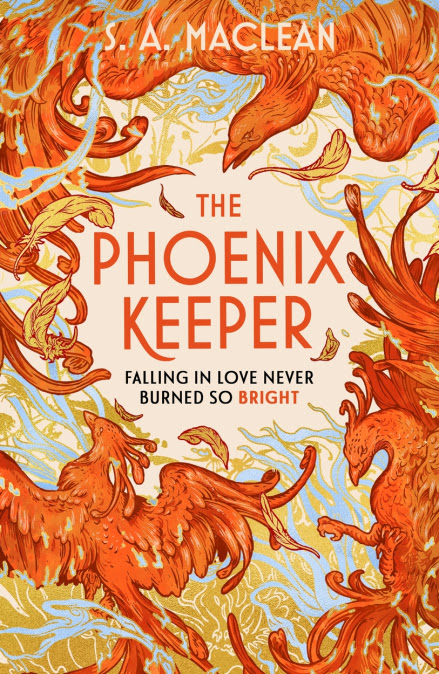
Review - The Phoenix Keeper by S A McLean


The Phoenix Keeper by S A McLean - cover

The Phoenix Keeper is an accomplished cozy fantasy that introduces new elements into its story while also keeping us in touch with some that are familiar. In a setting that seems parallel to the real world, a zoo containing magical creatures is looked after by Aila and her best friend, Tanya. What we get are superior world-building (probably influenced by the author's background as an ecologist), lively interactions, humour, real concern about the endangerment of animals, lucid descriptions and a genuinely satisfying finale. There are strong friendship and romance bits to the story, and a refreshing viewpoint from a main character with social anxiety. My only small criticism is that two of the main plot happenings felt like they could be predicted from a mile away. But that doesn't stop it being a truly satisfying book.

Aila, the main character, struggles with her life-long anxiety around strangers and large groups. She is an expert in her field, devoted to saving the lives of endangered phoenixes through a breeding program at the San Tamculo zoo. This city strongly resembles San Francisco and the environment seems much like our own, with smartphones and social media like 'Griffingram'. The zoo itself is described vividly and we get a clear picture of tourist crowds, night atmosphere and the animals' habitats and individual personalities. 

Aila's best friend is Tanya, committed and brave. Tanya has her own goal: a volunteering program to assist the zoo. We get to experience the strong friendship between Aila and Tanya, and though their amusing, cheeky interactions can see how much they genuinely care about each other. However, Aila's single-minded obsession with phoenixes can be a weakness, and she must re-learn to pay attention to Tanya's need for help.

Spoiler warning

Luciana is another zookeeper who seems eerily perfect, and is a person Aila has had a long dislike for because of a past misunderstanding. We find out eventually that Luciana conceals a vulnerability when she must deal with the loss of her own creature, a griffin. By gradually co-operating with Aila, we see her barriers break down. 

Then there's an 'enemies-to-lovers' trope as Aila and Luciana's difficulties are reconciled, and through this fresh understanding a romance develops. And another tried-and-true plot element appears later when a 'dark horse' character betrays Aila in a plot against her precious animals. While there's nothing wrong with all this, they're hardly unexpected events when they eventually occur.

The final chase sequence, however, kept me in genuine suspense and was a great way to finish off the book. As was Aila's journey to finding love and personal freedom, with her successes in the faces of of her zoo colleagues, superiors and even a large audience.

Rating: 4 stars (out of 5)

⭐⭐⭐⭐

Thanks to Hatchett Book Group & Netgalley for an ARC of this book. 

Wednesday, 22 May 2024

Review - Jamaica Ginger and Other Concoctions by Nalo Hopkinson


Review - Jamaica Ginger and Other Concoctions by Nalo Hopkinson
I had encountered some of Nalo Hopkinson's stories before starting this collection and admired them. So it's with pleasure I can say this is another varied set with which she shows a talent for making strange and thought-provoking tales with concerns including Western and Caribbean cultures, gender, climate change and adaptation and resilience. And cute swimming pigs!

'Broad Dutty Water' is one of the longest and strongest stories. Jacquee is a young female member of a 'taz', an ocean farming cooperative created after a catastrophic climactic flooding process, the Inundation, that has affected the local Caribbean environment. She has received a new 'wetware' cybernetic implant which allows her to bond with and control machines like her ultralight flying craft. Her unpreparedness with the implant is partly what causes her plane to crash on an isolated island, where she must fend for herself. While there, she discovers miraculous 'blob stuff' in a lagoon which may hold the key to preserving endangered species in the face of climate doom. But it is the engaging language and interaction of Jacquee and the other characters in the story which is the most enjoyable.

In 'Jamaica Ginger, we get a 'teslapunk' tale about another young female protagonist in a setting that resembles early 20th century America with many of its racial attitudes. But the usual steampunk cliches are flipped on their head, as the main characters are now poor, disadvantaged people of colour. Plaquette is at the mercy of a master in his workshop, creating mechanical servants or 'Georges', despite that fact that she is the real talent behind his inventions. It's a well-crafted tale with an ending involving a departure to her own personal freedom.

Things take a darkly humourous tone with 'Inselburg', which is an often funny narration by a future Caribbean native tour guide. During his imaginary island tour ride, he also relates startling details about dire flooding and an environment that is surviving despite ecological poisoning and disaster. There are also some wicked jabs about foreign tourists and a stark lack of compassion by the guide, as he passes on his cheeky, deadpan way. 'Repatriation' is another related story, in which a local Caribbean couple must deal with their own feelings when taking part in a tourist cruise, awkwardly finding that all the serving people on the ship are of their own background. But it ends with another burst of hope for the future against climate change.

It might be just my own preference, but the fantasy tale 'San Humanite' is my favourite. It is really just all about a general feeling and aesthetic, which really worked for me. It has the best weird atmosphere in any story this side of H.P Lovecraft. Also 'Whimper' is another tale with a surreal tone, but this time a nightmare.

I would say the parts of this collection that worked best for me were the author's energetic use of Caribbean vernacular, a grasp that is very convincing, at least to an outsider. There's a wide variety in the stories, from slice-of-life ('Waving at Trains'), to blisteringly fast microfiction, to eerie interactions with mysterious creatures ('Child Moon'). Hopkinson's focus on rising sea levels and their effects on island nations is a worthy one. However, her sometimes angry stories may not be for every one - despite how historically racially justified they may be. 'Clap Back' is a story that will get almost any reader feeling indignant, and is a viciously sly satire focused at the misuse of the identity of people from developing countries in Western marketing and fashion. However, I was left wishing there was a bit more balance in the racial approaches in some of the stories.

The author has a great way of telling tales, regardless, and it's clear she has things that are important to tell.

Rating: 4 stars (out of 5)

⭐⭐⭐⭐

Friday, 19 April 2024

Review - The Fall Is All There Is by C.M Caplan


Cover - The Fall Is All There Is by C.M Caplan

Review - The Fall Is All There Is (Four of Mercies Book 1) by C.M Caplan

In this book, we follow the story of Petre Mercy, a member of a royal family in a setting that resembles a possible future Earth. Petre is part of a family dynasty that was begun by a cruel father, and he and his siblings must find their separate ways forward after the king's death. The story is told in the first person, from the viewpoint of Prince Petre, an authentically portrayed (high-functioning) autistic character, who has run away from his family background. 

The setting is that of a world recovering from several waves of scientific advances then 'annihilations'. Cyborg animals like horses are organically grown, then mechanically implanted with clockwork-style technology. This hybrid, fantastical technology co-exists with a social structure like that of the feudal houses of Europe. The air surrounding recent battles or places of death is possessed by 'gaunts', ghosts that may infect ordinary people. These atmospheric details are some of my favourite parts of the book (although I was left wishing there were more).

The main character, Petre, struggles with his neuro-divergent condition and his own limitations. He tries to resist 'stimming' in order to blend in with others; he is hyper-sensitive and sounds like fingernails drumming make him experience a 'sensory nightmare'; he hyperfocuses on mundane details like a cut on skin; and he must often retreat from too much stimulus. Petre must take regular, chemical injections to increase his reflexes, strength and capabilities and help with 'fitting in'. He is flagrantly bisexual and finds it hard to control and resist his impulses. 

The plot of the story mainly revolves around Petre's dealings with his siblings. Edgar is shown to be a shady, manipulative, Machiavellian character who tries to lure Petre into his custody. The split between Petre and his brother is a shocking one in the early part of the book. Anoise is the new heir to the throne, the oldest, and is trying to find a way past her own inexperience and cautious nature and to retain her grip on newfound power. Desmon is the diplomat, and ultimately proves himself courageous in a difficult journey with his brother.

We see how the others around Petre deal with him and his condition. Some treat it as something to step around; Edgar falsely offers to embrace Petre's nature; while his mother is cold and critical. He relates how she would 'get scornful and start talking about the autism. The way she wished that she could cure it, the way it was hurting everyone around me'. This was a convincing and sympathetic portrayal of family life for someone with a disorder.

Some parts of the novel did not work for me: I thought a lot of the long, drawn-out dialogues had a sensational tone (although this probably again reflects overly Petre's sensitive nature). The author himself, with the story, shows some of the traits of the main character: indulgently focusing on some things (like descriptions of rats in the dark), and an impulse to keep holding up the awkwardness of prolonged dialogue.

However, these are small things and it's overall a promising book. The last quarter of the book has a gripping journey, a wicked betrayal and begins development of the military conflict. If the next book can carry out the kind of tight story of that quarter, I'll look forward to the next volume.

Rating: 3 stars (out of 5)

⭐⭐⭐

Friday, 12 April 2024

Review - The Wickwire Watch by Jacquelyn Hagen


Review - The Wickwire Watch by Jacquelyn Hagen (Riverfall Chronicles #1)

I finished this book today as part of my ongoing mission to get through more of the SPFBO 9 competition finalist novels. Although I find myself a bit late to reviewing this novel (there are already two sequels out at the time of writing), it's better late than never to write a review.

The setting of this one resembles mid-to-late 19th century Europe, with some subtly defined steampunk elements lurking in the background. After a historical incident in which an important leader was murdered, there is a rift left between the the two main peoples of the story: the Cassians, who rely on mundane technology, engineering and science; and the Entrians, an aloof, erudite people who wield the powers of mysterious magic. 

Inkwell, the most important main character, is a young teenage orphan who has escaped an orphanage when he encounters a group of refugees, the Colonists. He meets them while fleeing a strange happening while investigating an abandoned house, and has discovered an arcane artifact, a pocket watch. From there, he is taken to the hidden, floating community of the Colonists, Riverfall. Here we are introduced to a variety of characters, and Ink comes to question the dire accusations that have previously been made against the Colonists, while he also becomes part of their village. 

I found the characters in Riverfall well-defined, and we get to hear the secrets of Delia, Simon, Erving and others. There are some sections while in Riverfall that resemble a cozy fantasy atmosphere: this is nothing to change or lower the quality of story, but a reader has to be prepared to take on a great slowing of the pace in these domestic sequences. Ink is gradually absorbed into the community of Riverfall, despite his long-held suspicious nature, and he ponders a lot on the reliability of "the truth" as many have understood it. Caradoc is the heroic, strong-willed leader that the Colonists rely on because of a magical attribute he possesses, and Ink finds himself coming to trust him more and more. 

However, things greatly change in the second half of the novel when Inkwell learns more of the secrets and nature of the Spektors, a group of ghostly, cursed creatures who have been pursuing him. I found this latter half more interesting, since the exposition was now over and Ink becomes involved in several escapades that make him question the truths he has understood once more. He must decide whether to believe Caradoc, Seherene (a dedicated Entrian hunter of the Colonists), or a Spektor he finds was once his relative. We see Caradoc exposed as more of a flawed, realistic character, and Ink negotiating his way through the uncertain waters of events.

This was an enjoyable novel, although it was odd to find myself liking the character details and verbal interactions on Riverfall while also being impatient for some more action to commence. Inkwell is a colourful, unpredictable Artful Dodger character and there were some clever fantasy touches. We are left wondering what deal he has worked out with Seherene to continue, and what his agenda will be going forward, and if he can get away with it. The path is open for the sequels, and I hope personally to see more of the steampunk background and elusive, Entrian magic.


Rating: 4 stars (out of 5)

⭐⭐⭐⭐

Tuesday, 12 March 2024

Review - Born of Light and Shadow by Ryan Kirk


Born of Light and Shadow by Ryan Kirk - Cover

Review - Born of Light and Shadow by Ryan Kirk (Legend of the Adani #1)

At first, I thought this would be another solid adventure fantasy by the author. But it emerged as something far better than that, and so far it's my favourite read of 2024! In a world where most humans can wield a type of magical force known as adani, two siblings must set out in order to overcome the forces of the Debru, a sinister, supernatural race of shadow creatures. Dead circles of grass have emerged that threaten their world. Elian seeks to warn others of this sign, also seeking recognition as a warrior, while his sister, Samora, is more interested in using magical bindings for the healing and growth of their world. There's a gripping final third of the book, and as a wonderful addition we get sentient dragons inserted to the mix as well.

The world-building is detailed and deceptively understated. The people of the book are divided into those of the Villages, who farm and provide food for others, and the Wandering Clans, whose duty is to protect all against the threat of the Debru. The clans have been fighting a long, losing war against the Debru: they must protect their territories but also have a tendency not to trust one another. Likewise, Elian and Samora's village must deal with the trauma of some of their members killed by the Debru, including their own father.

Elian dreams of becoming a great warrior, partly out of desire to revenge his father. But he is unique and cannot manipulate the bindings of the adani magic, and must deal with feelings of inadequacy. This is until he finds he does indeed have a rarer talent, that of diverting magical flows inside himself. He discovers that his strength is born of desperation, impulse and need. His relationship with Harald, the wily, but heroic and committed clan leader, lets him develop his abilities and grow throughout the novel.

His sister, Samora, is an opposite. She is naturally talented at magical binding and is highly sensitive to the flows of adani around her. From this, we get a realistic depiction of an introverted main character who retreats from the overly stimulating adani flows she senses around her, speaking out seldom, but is still able to always keep a reserve of quiet strength. Samora learns from several mentors in the art of healing. She also attracts a follower and defender, Karla, a much older master adanist and former warrior chief. Karla is another accomplished introverted character: she is strong, tough and fatalistic. Together they must go forth on an independent mission of their own, to seek out the heart of the mystery behind the Debru and the dying circles of land.

The challenge of these dead circles lets out some revelations of the secrets behind the shadow creatures. There are the kettu, dog-like attackers; the otsoa, something like shadow-wolves; the debru, foot soldiers commanding these inferior forces; and the belog, lordly, dark sorcerers who direct the malevolent troops. But the fading circles are also bound up with a mystery that involves the last diabolical Debru type, the Vada, the most fearsome, resembling demonic gods.

This central puzzle behind the origins of the Debru is partially revealed in tantalising visions experienced by Samora. Who are the strange people she sees conducting a doom-laden ritual? Why do the Debru creatures just stand still, never eating, and why do they seek to attack all humans? I guess we'll have to wait till book 2 to find out. The dead circles of land, bound with the Debru, are countered by the Gathering Grounds of the clans, places of regeneration, overwhelming magic, growth and healing. Once again, I enjoyed Kirk's use of areas of spiritual sanctuary in his world.

The last third of the book is full of engaging plot revelations and action, as it should be. Characters must also deal with the added threat of possession by the shadow creatures, an interesting complication. I particularly enjoyed the characters of the dragons uncovered by Elian, and Elian's own path of self-discovery, accomplishment and redemption in the face of battle. The overall message that main characters discover is a satisfying one, that they must work in harmony with their world and the forces of nature magic, in order to reach a successful outcome. The magical system itself has some deceptively deep concepts, in particular its similarity to ideas of karma and self-healing systems of the natural world. It's pleasing to see what the author can achieve without the bloat of other epic fantasy series. I have no hesitation in recommending this classy, enjoyable book and am definitely going to look out for the next in the series.

Thanks to Netgalley and Xpresso Book Tours for an ARC of this book.

Rating: 5 stars (out of 5)

⭐⭐⭐⭐⭐